BharatNet Phase III:
Connecting Rural India at Unprecedented Scale
NCC is the core turnkey partner delivering the middle-mile network across Madhya Pradesh & Uttarakhand from design and fibre deployment to a decade of operational excellence.
The Challenge
Bridging India's Digital Divide
Despite two earlier phases, large parts of rural India remained underserved — with fragile linear topologies, underutilised capacity, and a widening gap between urban and rural broadband access. Phase III was conceived to fundamentally redesign the network for resilience, 5G readiness, and measurable service outcomes.
Fragile Linear Architecture
A single fibre cut could isolate entire blocks. The existing network lacked ring-based redundancy, making uptime guarantees difficult.
Multi-Vendor Coordination
Previous phases suffered from fragmented execution — separate agencies for civil works, equipment supply, and maintenance created accountability gaps.
Terrain & Right-of-Way
Madhya Pradesh's forests and Uttarakhand's mountains posed extreme challenges for trenching, tower installation, and regulatory approvals.
Demand & Utilisation
Connecting Gram Panchayats didn't guarantee adoption. Affordable plans, digital literacy, and reliable last-mile service were essential.
Technical & Delivery Model of BharatNet Phase-3
A three-tier implementation model ensures end-to-end coverage — from backbone bandwidth to the last-mile household connection.
Backhaul / IL Bandwidth
BSNL supplies Internet Leased Lines and backbone connectivity to blocks and regions, providing the core bandwidth pipe that feeds the entire downstream network.
Middle-Mile Network
Optical fibre and wireless infrastructure owned by the project, with private agencies like NCC appointed to build, operate, and maintain under 10-year O&M contracts.
Last-Mile Access
Last-mile to homes using Wi-Fi, unlicensed-band wireless, or local fibre — delivered via Udyami micro-entrepreneurs or local service providers to drive household adoption.
Technology Mix
OFC is the primary medium, supplemented by Unlicensed Band Radios (UBR), Microwave links, and satellite in hard-to-reach areas. The entire design anticipates 4G & 5G backhaul needs from day one.
Our Approach
Single-Point Accountability, End-to-End Delivery
NCC's integrated model eliminates the fragmentation that slowed earlier phases. Every layer — civil, fibre, active equipment, power, and long-term O&M — is delivered under one accountable entity.
Resilient Ring Topology
Transitioned the middle-mile from linear to ring architecture using IP/MPLS, ensuring no single point of failure across 411 block sites.

Unified Design-Build-Operate
One contract, one team — from BIM-driven design and OFC laying to commissioning and 10-year maintenance.

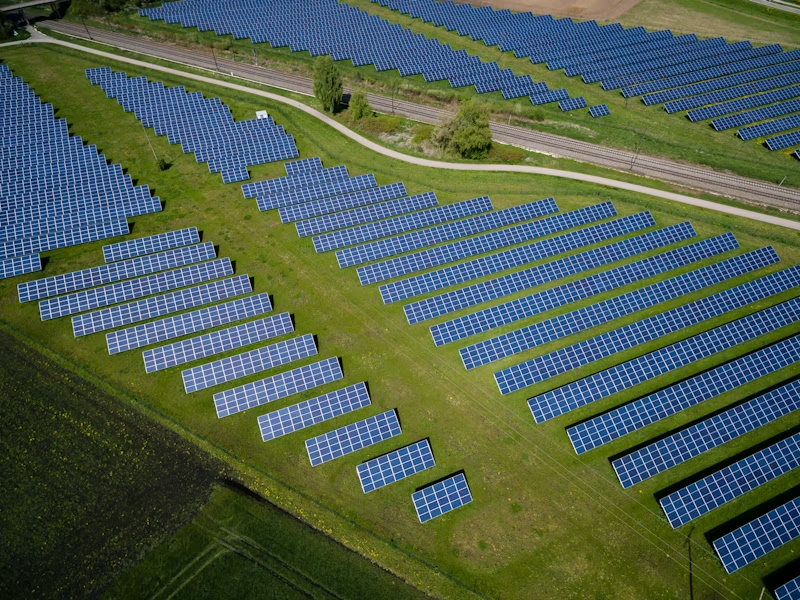
Sustainable Power
15 MW of distributed solar across sites, ensuring uptime in areas with unreliable grid supply.
Centralised Command & Control
24×7 Smart NOC in Bhopal & Dehradun, with GIS geo-tagging of 1.75 lakh km of network assets for real-time visibility.

Technology Partnerships
Tejas Networks for indigenous IP/MPLS routers; Echelon Edge for unified OSS/NMS platform.

Built for Resilience, Ready for 5G
The network is architected as a future-proof national asset — capable of supporting 5G backhaul, enterprise VPNs, and bandwidth leasing for decades.
IP/MPLS Routing
31,000+ nodes deployed with ring topology, enabling smart routing, traffic engineering, and sub-50ms failover.
Unified OSS/NMS
Centralised platform by Echelon Edge for element management, service assurance, predictive analytics, and SLA governance.
GIS Asset Management
1.75 lakh km of network assets geo-tagged for virtual inspection, route planning, and digital twin readiness.
Distributed Solar
15 MW solar capacity integrated across sites, reducing diesel dependency and ensuring green, uninterrupted operations.
24×7 Smart NOC
Dual NOC in Bhopal & Dehradun for round-the-clock monitoring, proactive incident management, and network health analytics.
5G-Ready Backhaul
Designed with capacity headroom and fronthaul/backhaul readiness to support 5G rollouts as spectrum allocation matures.
Impact & Milestones
Beyond engineering metrics, BharatNet Phase III is a socio-economic platform that transforms lives across rural India.
Telemedicine
Real-time video consultations & remote diagnostics for underserved communities.
E-Education
Reliable connectivity powering digital classrooms and remote learning across rural schools.
E-Governance
Seamless delivery of government services, digital payments, and financial inclusion.
Rural Entrepreneurship
Udyami model empowers local micro-ISPs & MSMEs with digital market access.
4G & 5G Enablement
Neutral host middle-mile network accessible to all telecom operators.
Sustainable Operations
Solar-powered sites & centralised NOC reduce carbon footprint across operations.
Lessons Applied
Why This Project Is Different
Hard-won lessons from previous phases incorporated into NCC's execution model.
Design for Operations
10-year O&M is baked into the contract from day one — with SLAs, performance monitoring, and outcome-linked payments.
Flexible Technology Mix
OFC is primary, but the design accommodates wireless and satellite fallbacks for difficult terrain.
Demand Stimulation
Subsidised household Wi-Fi, digital literacy programs, and Udyami partnerships drive adoption beyond mere connectivity.
Transparent Governance
Monthly district-level KPIs, GIS-based asset tracking, and centralised NOC reporting ensure accountability to all stakeholders.


Want to discuss a similar project?
Our integrated telecom infrastructure model scales from rural broadband to dense urban 5G. Let's talk about your network.
- End-to-end turnkey execution
- 24/7 NOC & O&M capabilities
- Indigenous 5G-ready design
- Sustainable & solar-powered infrastructure